
Utrecht, the fourth largest city in the Netherlands. Known for its vibrant, yet intimate medieval setting, this medium-size metropolis featuring storybook canals, a bustling cycling culture, and ancient architecture that people travel around the world to see. It’s often considered a cozier, less crowded alternative to Amsterdam.
More importantly to farmers over 7,000 kilometers away in Southern Alberta, it’s the birthplace of Dr. Thierry Fonville.
He is the Research Scientist and, currently, sole PhD at Farming Smarter.
Thierry plays an integral role in developing research projects, coming up with new practices or fine-tuning existing ones, and researching different crops and technologies.
He also serves as the bridge between Farming Smarter’s research teams and the funding organizations that support them. Thierry ensures each trial meets the needs of producers and agri-businesses while aligning with the priorities of governments and private funders.
Growing up in a larger city, Thierry says there weren’t many opportunities to experience agriculture and rural life in his youth. However, he always enjoyed being outdoors, especially as a child, and always made time for the “classic Dutch things” he loved like swimming and soccer.
Equally important to Thierry was getting a strong education.
Thierry earned a bachelor’s degree in biology and a master’s in biogeology at Utrecht University, citing a strong interest in plant science. He later transitioned to archeology and obtained his PhD in geography at the University of Southampton in the U.K., after becoming fascinated by ancient settlements.
| “I loved trying to figure out what people were growing, how they were living, how they managed the land around where they lived thousands of years ago. We found traces of animal bones and livestock, but also how they were growing crops,” says Thierry. |
He investigated several areas in Scotland and Wales, and one of his more notable expeditions included looking into a crannog that was built in the middle of a Scottish lake.
Crannogs are a type of roundhouse, or a circular home, built over water to create an artificial island that was common in the northwestern parts of the British Isles from the late prehistoric until the early Medieval periods.
| “We think they were built that way for defensive reasons or to store high value goods on them. But we were also curious about simple things like where people store their grain and how they make sure that the neighboring tribe doesn't run off with it.” |
He continued to explore the topic as a Research Fellow in Southampton after his PhD, but as much as archeology was interesting to Thierry, he wasn’t sure if it was what he wanted to dedicate his life to. He says it’s a very theoretical subject that often doesn’t directly benefit society.
| Thierry explains, “It's all about things that happened in the past and trying to understand it, and I think that I was missing the practical, real impact. People are super interested in archeology, but it doesn't really help people in any way.” |
As he took some time to think about his career trajectory, his wife, Sarah Pogue, got a job as a physical scientist at the Agriculture and Agri-food Canada (AAFC) Research Centre in Lethbridge.
Canada was always high on Thierry’s list of places to live, and the beauty of southern Alberta certainly sweetened the opportunity. The rolling prairies backing onto the majestic and imposing Rocky Mountains made it an easy “yes” to follow Sarah across the pond.
Thierry soon understood that agriculture is what he had wanted to pursue this entire time, even if he had never fully realized it. From spending as much time outdoors as he could as a child to his interest in plant science and studying ancient agricultural practices, agronomy was the perfect fit.
He completed a two-year postdoc study into regenerative agricultural practices in partnership with the University of Alberta and the Lethbridge AAFC Research Centre. Thierry studied soil nutrients and examined how techniques like rotational grazing, highly diverse crop rotations, and livestock integration could help to improve soil health.
|
|
|
Dr. Thierry Fonville (right) speaks with a public attendee about soil health and texture during at a Farming Smarter booth during the Open Farm Day event in 2025. |
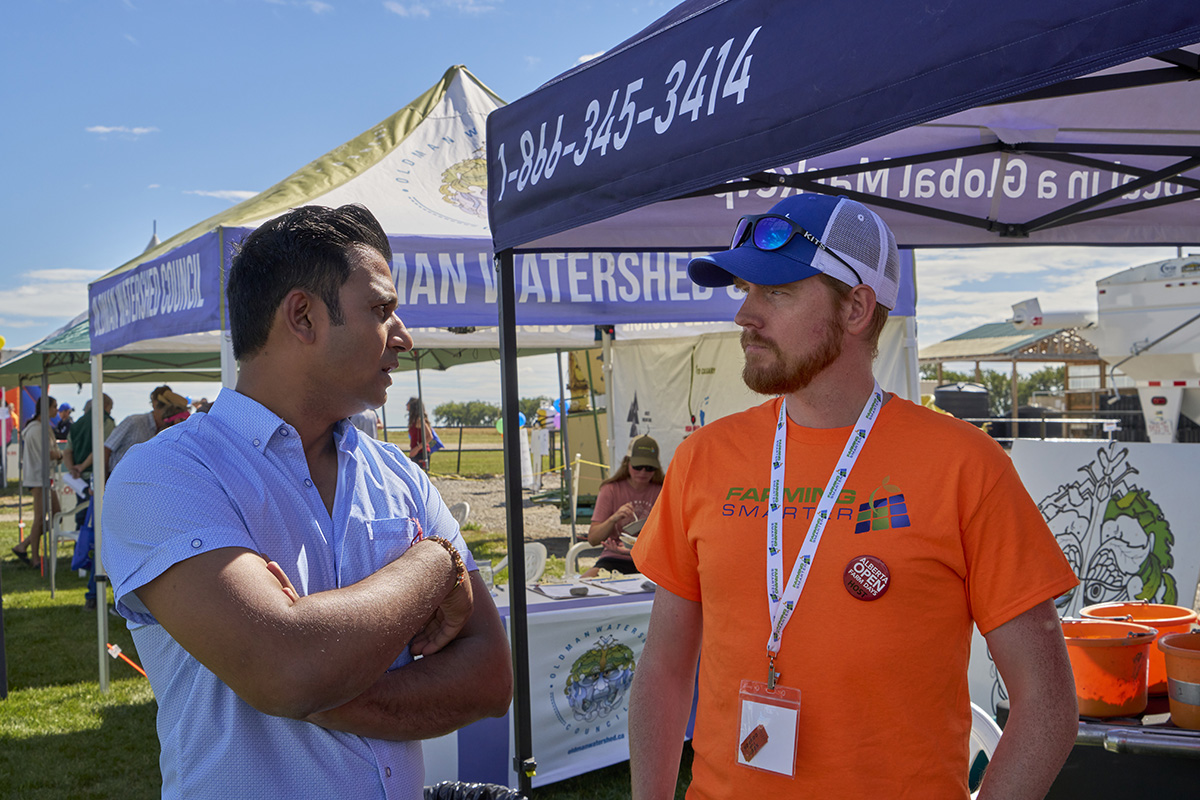
Afterwards, he had a series of conversations with Ken Coles, Farming Smarter’s Executive Director. The pair discussed what was needed from the open researcher position and to see how Thierry would fit in with the registered charity.
Thierry was thrilled to learn about the sustainable agriculture work Farming Smarter had underway and eagerly accepted the opportunity to join the team in 2024.
| “I feel very proud of the impact we make at Farming Smarter – improving sustainability, livelihood, and helping to put food on the table. That gets me really excited about working here,” Thierry says. |
The first paper that Thierry published at Farming Smarter was Strip Tillage and Precision Planting for Canola, a project that had just been completed the year prior to his employment. He looked at the project results, conducted data analysis, and wrote a scientific article that was up to international standards.
It investigated different tillage systems and seeding techniques for canola. He found that there weren’t any major differences in crop quality and yields between no-tillage, reduced tillage, and traditional tillage systems.
| “That would suggest that there are no real significant losses from reducing your tillage overall in both the irrigated and rain-fed systems for canola. This tells us that sustainable practices can be just as profitable as more traditional systems, where there's a lot more mechanical disruption of the soil, which might lead to further losses of soil quality in the long run,” says Thierry. |
Thierry has also been involved in the post-project analysis of Grain Corn Agronomy and the corn component of Perfectly Placed. Both projects investigated grain corn production in rainfed systems to determine optimal seeding and fertilizer rates. He found that, in years with higher precipitation, you can increase your seeding rate to get a higher yield. But in drier years, you’re essentially “burning money” by increasing seeding or fertilizer rates, as they had little impact on yield or quality.
| “This is a nice example of that practical, directly transferable knowledge that we get from our farm research trials. These insights help farmers to get the most out of their operations.” |
Thierry had spent several years stuck in a lab or behind a computer with limited time to get outside and work with his hands prior to working at Farming Smarter. Although he probably spends the most time inside out of our researchers, he enjoys the flexibility that Farming Smarter provides.
| “It's exciting to go out and talk to producers to learn about their challenges,” says Fonville. “I also enjoy just being in the field, counting plants, seeing how the crop develops, investigating new crops that maybe people haven't thought about growing here before, seeing how different varieties perform, and trying to develop new practices on the sustainable side of things.” |
After Thierry and Sarah leave work, they continue to do similar work, implementing sustainable practices at home in their garden. Along with finding ways to reduce their water and fertilizer use, they have seeded more native flowers and grasses this year.
They have an eight-year-old Australian cattle dog named Bella, who Thierry describes as a “little Ferrari that goes from 0-100 in a second.” She often joins them on hiking trips, and once decided that she would jump off a 12-foot cliff instead of taking the nearby stairs. “Who knew that dogs could fly?” Thierry joked.
To learn more about Thierry and his work at Farming Smarter, get in touch with him.
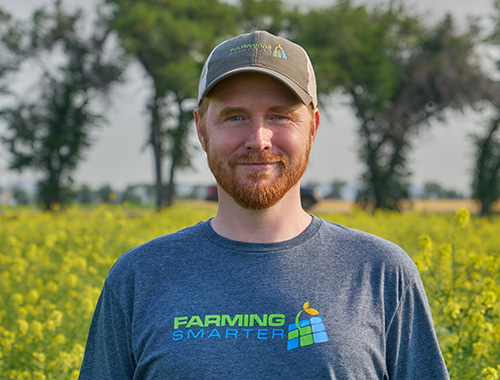
Get in Touch with Dr. Thierry Fonville
|
||||
|
|
Building and Inspiring a Culture of Innovation in Western Canada AgricultureFarming Smarter is an agriculture innovation hub based out of Lethbridge, Alberta. Our mission is to support the people involved in advancing irrigated and dryland crop production. We work closely with farmers, entrepreneurs, businesses, government, academia and more to bridge the innovation gap, drive economic growth, improve social impact and environmental sustainability. We are a policy governed, non-profit organization with by-laws under the Alberta Societies Act, and a Canadian Charity registered under the Canada Revenue Agency. If you like what we do, please consider supporting Farming Smarter by making a donation, sponsoring us, or come to us for your agricultural research needs. Innovation is hard and about long-term results. We invite anyone interested in agriculture innovation to work with us and together we can change the way people farm. |