
It’s a hot summer day in southern Alberta. You step out of your home and look out into the vast expanse of irrigated farmland, taking in the view of a seemingly endless blue sky. You hear the quiet rolling sounds of your pivots making their rounds, and you think to yourself, “life is good”.
Then, out of nowhere, your pivot stops.
You head out into the field, trying to figure out what happened. Nothing looks out of the ordinary, yet you can’t get the sprinklers to turn back on.
You call every technician in the region, but nobody will be available this week. You were on a tight schedule as it was, and this will surely put you behind.
A technician eventually does come, and it turns out that all you needed to do was flip an electrical switch. If only you knew how the electrical components of your pivot worked, you could’ve got it back up and running in no time without needing to call anyone!
Sean Zdun of Pivot Pro Ag has encountered this exact situation many times over his 20+ year career and says it’s important for farmers to have at least a base understanding of how their pivots work.
After all, Southern Alberta is home to more than 70% of all irrigated farmland in the country, according to the Alberta Government, and finding a qualified technician who can get out to your farm quickly is often a challenge.
This situation led to the creation of the first-ever Pivot School on June 3. Zdun says he chose to work with Farming Smarter to create the educational session because it had everything he would need – the classroom, the pivots, and the name recognition that farmers in the area know and trust.
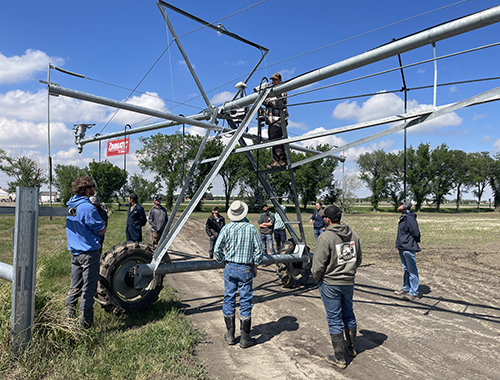
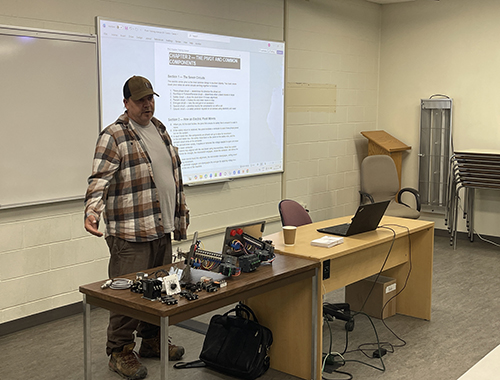
The session saw Zdun provide farmers with the knowledge on how the electrical circuits make their pivots function and how to diagnose and repair common issues themselves. This included a trip into the field for a hands-on demonstration with a pivot.
Zdun says it was important to make sure he was providing universal pivot knowledge that wasn’t brand specific.
| “All pivots essentially operate the same, even though they have different controllers. If you can break down a pivot into its circuits and you know how to troubleshoot them, it'll make your life a lot easier in the long run,” says Zdun. |
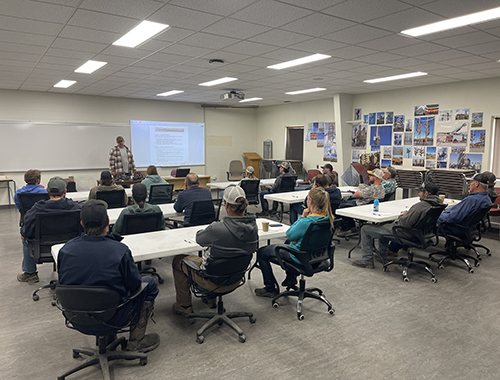
Zdun was pleasantly surprised to see people from a wide range of operations and communities packing the Farming Smarter classroom, despite his uncertainty of how everything would go and how many people would be interested.
Carlo Van Herk, Field Operations Lead at Farming Smarter, says Pivot School provided him with a lot of valuable information that will help him in his field work. He adds that, prior to attending, he didn’t know how much he didn’t know about irrigation pivots.
While many of the attendees were from Southern Alberta, one man made the 5.5 hours trek from Elbow, Saskatchewan to Lethbridge to attend the session.
Stuart Ector works on a farm that grows crops like canola, durum, lentils, chickpeas, rye, and beans, and had set up their first pivot a couple of years ago.
He says Pivot School was a great opportunity to learn more about irrigation infrastructure so he could set his operation up for success.
|
“Our area is historically dry and there's not many years where irrigation would not come in handy. We thought it was finally time to invest in some infrastructure and kind of control our own destiny,” says Ector. He adds, “I’m trying to take advantage of every opportunity to get a little more information and keep ourselves going in the growing season. Pivot School was a good breakdown and an excellent explanation of each of the circuits.” |
With this being the first edition of Pivot School, both Zdun and Farming Smarter considered it a bit of a trial run. Zdun has done individual training sessions on farms in the past, but he wasn’t sure how things would go with a more formal classroom setting.
He was encouraged by the positive feedback he received. Although nothing is confirmed yet, Zdun expressed interest in hosting a similar event in the future, and potentially, an advanced “masterclass.”
If you are interested in attending events that will increase your agricultural knowledge, you can still register for the Farming Smarter Field School on June 25 and July 16. The events offer a full day of research updates and in-field demonstrations with speakers and guests who want to learn more about agriculture and ag-related products.
You can learn more about Field School and register to attend here.
|
|
|
Pivot School attendees took part in a hands-on, in-field demonstration. |
|
|
|
A full classroom takes in lessons about irrigation pivot management. |
|
|
|
Sean Zdun provides an engaging lesson about irrigation pivot components. |
|
|
Building and Inspiring a Culture of Innovation in Western Canada AgricultureFarming Smarter is an agriculture innovation hub based out of Lethbridge, Alberta. Our mission is to support the people involved in advancing irrigated and dryland crop production. We work closely with farmers, entrepreneurs, businesses, government, academia and more to bridge the innovation gap, drive economic growth, improve social impact and environmental sustainability. We are a policy governed, non-profit organization with by-laws under the Alberta Societies Act, and a Canadian Charity registered under the Canada Revenue Agency. If you like what we do, please consider supporting Farming Smarter by making a donation, sponsoring us, or come to us for your agricultural research needs. Innovation is hard and about long-term results. We invite anyone interested in agriculture innovation to work with us and together we can change the way people farm. |