
Having grown up in a community surrounded by agriculture, Lewis Baarda expected his career to have some involvement with the industry.
Yet he never imagined himself leading a research program of on-farm and field-scale agronomy trials to improve that very same industry.
“Agriculture is one of those things that if you grew up in it, it’s kind of a way of life,” Lewis reflects. Growing up on the farm defined the early years of Lewis’ life; his chores and early summer jobs were helping around the farm, feeding animals and later operating equipment.
As a naturally curious person, he grew an innate interest to the field the longer he spent in it but was never married to the idea of making it a career.
“It kind of underpins who I am. I live in a community that’s very agriculturally based, it’s where I grew up and a lot of my peers are in agriculture – it’s just part of my DNA in a sense,” Lewis comments. “It was just never something I pinpointed for a career.”
Instead, his interests in geography, mapping, and the outdoors would take his career towards the world of Geography.
|
|
|
Lewis Baarda poses for a photo in the field while overseeing seeding for a Field Tested research trial at Farming Smarter, 2021. |
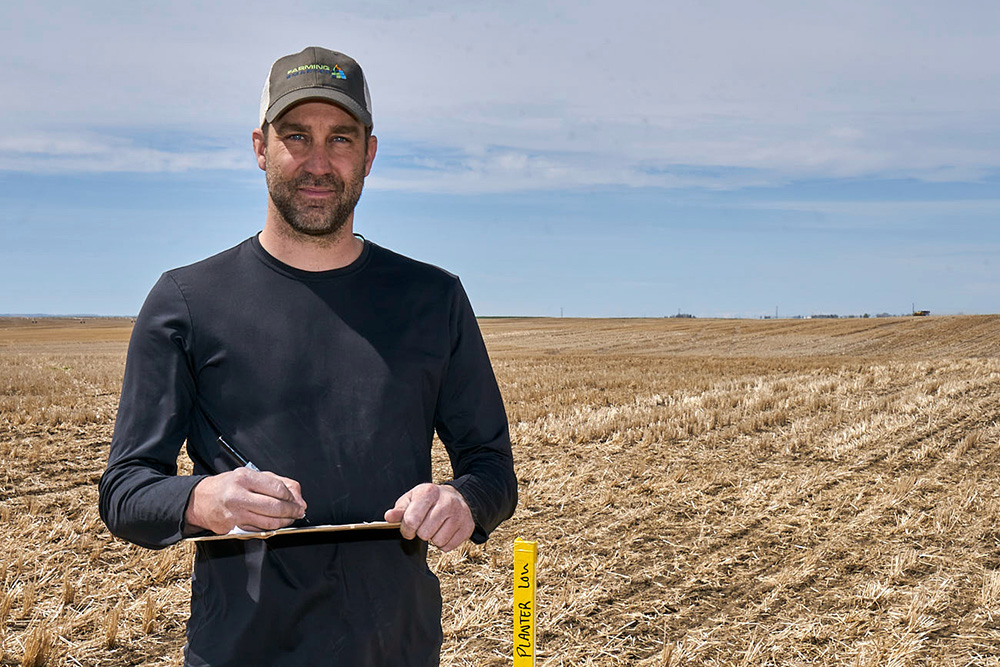
Like many, Lewis had no clear vision of where he wanted his career to take him. However, he quickly fell in love with the spatial side of geography and selected courses that built skills that he enjoyed getting to use.
“I think a lot of science degrees are that way. You’re not sure where you’re going to end up, so you just kind of figure out what interests you and you make opportunities along the way,” Lewis shares in his reflection.
Coincidentally, it was this decision that would eventually lead him to building a career at Farming Smarter.
Lewis graduated from the University of Lethbridge with a Bachelor of Science in Geography and soon after began a Master’s project investigating the geographical impacts of mad cow disease shortly after its discovery in Canada in 2003.
The project provided a geographical perspective to an economic problem that affected the cattle industry around Lewis’ hometown of Picture Butte, Alberta. It also provided Lewis with the necessary skills to apply for a job managing the spatial analysis of a variable rate fertilizer project at a local research station called Farming Smarter in 2014.
Lewis' first project at Farming Smarter was Understanding Soil Variability for Effective Zone Management in Precision Agriculture - an early foray into precision agriculture research for the not-for-profit research organization.
It allowed him to flex his geographical knowledge and spatial analysis skills while he got to shake the rust off his old equipment driving skills and learn about crop production. Calling back to his curious roots, the opportunity to learn drove an interest to learn more, as Baarda jokes, “so I stuck around.”
Since starting at Farming Smarter, Lewis has become the leader of the non-profit charity’s on-farm research and recently expanded into irrigation projects and specialty crop agronomy. While this broad purview allows him to explore a suite of ideas and topics, the one consistent throughline of his position has been the work on variable rate, precision agriculture, and geospatial mapping.
Lewis has come to define the role as “a jack-of-all-trades” as he jokes, “I need a 20-floor building to give my elevator pitch at this point.”
Everybody contributes in all sorts of different ways, Lewis explains.
“The job is filled with all these incremental things,” he continues. “This isn’t the kind of job where you’re going to work on your Erin Brockovich law case for the next three years and have it be your career defining moment.”
Ultimately, Lewis sees himself as accountable for making sure that his research program is in good shape. “That means, we’re doing the right kind of research, we’re doing projects that farmers care about, and it’s getting done to a high standard of excellence.”
The on-farm research sees Lewis work closely with farmers across southern Alberta to bridge research from small-plot trials to the real-world conditions of farms. As Lewis summarizes, “we’ll find there are barriers to adoption or uptake because it just doesn’t make sense with the way a farmers grows, or because a farmer is locked into a piece of equipment or soil type.” Although it requires a bit more effort and energy on both sides, farmers have largely appreciated the value from being a part of the process.
“Nothing in agriculture is truly one-size-fits-all,” Lewis explains. “Farms are incredibly different from each other; whether it’s the size of your operation to the equipment, or even the number of fields you have. A farmer is going to have to adapt something from their neighbour’s situation to their situation.”
“We give you a partner to adapt that work with,” Lewis states.
Typically, Lewis will approach farmers to partner on a research project once it has secured funding support. However, it’s not uncommon for a farmer to approach Lewis with a challenge or question they’re interested in solving – which, he’s always happy to receive.
As Lewis prepares his program for the future, he’s excited for what lies in store. This year, he’s hired two full-time employees who have been eager to each manage a research stream in Lewis’ program and open the door for him to expand its reach.
Potato agronomy and exploring the many new advancements in irrigation technology are two key areas of research Lewis is more eager to take his program.
“There’s a lot of technology that isn’t helpful. It’s fancy but it doesn’t really move the needle,” Lewis says. “I want to find a place for the pieces that actually make a difference – that farm managers and operators would benefit from having.”
Outside of Farming Smarter, Lewis currently chairs the board of the newly established Lethbridge & District Agricultural Society, laying the groundwork for something that’s going to be a piece of the community for a long time.
After completing university and starting his career at Farming Smarter, Lewis and his family now live in the community where his agriculture journey began. When he’s not at work, Lewis enjoys spending time with his family, exploring the outdoors, and reading to keep his sharp wit honed.
Lewis returned to his hometown of Picture Butte where he and his wife are raising their three young kids.
Extra photo template
Copy & Paste this table & photo into your article if you need additional photos. Delete this block if you do not use it.
|
|
|
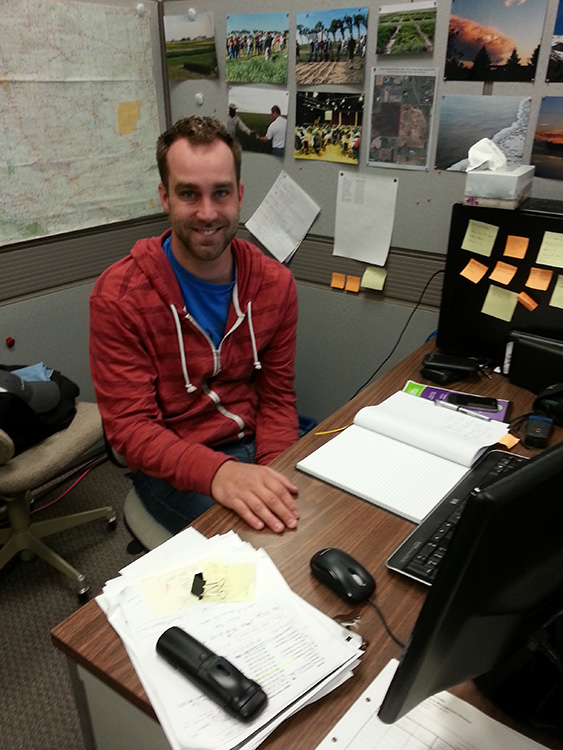
Lewis Baarda at his first desk at Farming Smarter, shortly after joining the team in 2014. |
|
|
Building and Inspiring a Culture of Innovation in Western Canada AgricultureFarming Smarter is an agriculture innovation hub based out of Lethbridge, Alberta. Our mission is to support the people involved in advancing irrigated and dryland crop production. We work closely with farmers, entrepreneurs, businesses, government, academia and more to bridge the innovation gap, drive economic growth, improve social impact and environmental sustainability. We are a policy governed, non-profit organization with by-laws under the Alberta Societies Act, and a Canadian Charity registered under the Canada Revenue Agency. If you like what we do, please consider supporting Farming Smarter by making a donation, sponsoring us, or come to us for your agricultural research needs. Innovation is hard and about long-term results. We invite anyone interested in agriculture innovation to work with us and together we can change the way people farm. |