
Written by Janet Kanters - for publication in the Spring 2026 Farming Smarter magazine.
In southern Alberta, specialty crops such as potatoes and sugar beets underpin entire processing industries, yet much of the agronomic knowledge used to grow them is imported from elsewhere.
That reliance on outside research is now being questioned, as growers, processors and applied researchers argue that local conditions demand local answers.
And it’s not only reliance on outside knowledge, although that is a limitation. Indeed, there is also the fact that due to southern Alberta’s unique context, we may need to be asking different questions than growers in other areas.
"Gaps in regional-specific research leaves growers adapting recommendations developed in places with different soils, climates and production systems." |
Those unanswered questions are what Farming Smarter Association’s Lewis Baarda calls “crop development holes” – gaps in region-specific research that leave growers adapting recommendations developed in places with different soils, climates and production systems.
“I think we’re focusing on some of those crop development holes,” said Baarda, field testing manager at Farming Smarter. “We’re working with a few different crops that are grown on pretty limited acres here in southern Alberta – potatoes and sugar beets, fresh vegetables like sweet corn and fresh peas, and even hemp.”
While these crops benefit from significant global research, Baarda said southern Alberta often falls through the cracks. “Potatoes are a really good example. There’s a lot of work done in eastern Canada, and Idaho has more potatoes than all of Canada,” he said. “But when you get to southern Alberta, we’re a pretty small region with small acres. Historically, we’ve pulled in knowledge from other places and applied it here.”
That approach worked when acreage was limited, he added, but the industry has changed. “Potatoes have grown a lot – almost 20, 30, 40 per cent in the last dozen years. Now we’re at the point where there’s enough momentum to start developing our own agronomy knowledge, right here at home."
McCain partnership highlights the need
The shift toward local research is evident in a new corporate partnership announced in 2025 between McCain Foods and Farming Smarter. McCain, which operates a major processing plant in Chin, Alta., works with the association to explore the viability of alternative potato varieties under southern Alberta conditions.
Farming Smarter conducts small plot research to run a trial growing four varieties under six different treatments. McCain is one of 30 companies that currently hold research contracts with the association.
The collaboration reflects a broader strategy by McCain to diversify its variety portfolio. For decades, North American research and commercial production focused heavily on Russet Burbank, a variety more than a century old. While Russet Burbank holds the largest share of potatoes grown, it is only one of dozens of potato varieties grown in Alberta.
And for McCain, introducing new varieties is only part of the equation. “When new varieties launch, they want growers to have full confidence in them,” Baarda said. “That means a detailed agronomic package and best management practices, tailored to this region.”
"Southern Alberta's irrigated systems, soil types and shorter growing season set it apart from many major potato regions." |
Why local data matters
Those packages cannot simply be copied from elsewhere, Baarda argued. “A variety might perform a certain way in eastern Canada or the Pacific Northwest, but what does it look like in southern Alberta?” he said. “How much water does it use here? How much fertility does it need? Does it still produce the right quality of potato?”
|
|
|
Local growers inspect potato plants from a Farming Smarter research trial at a McCain field day. |
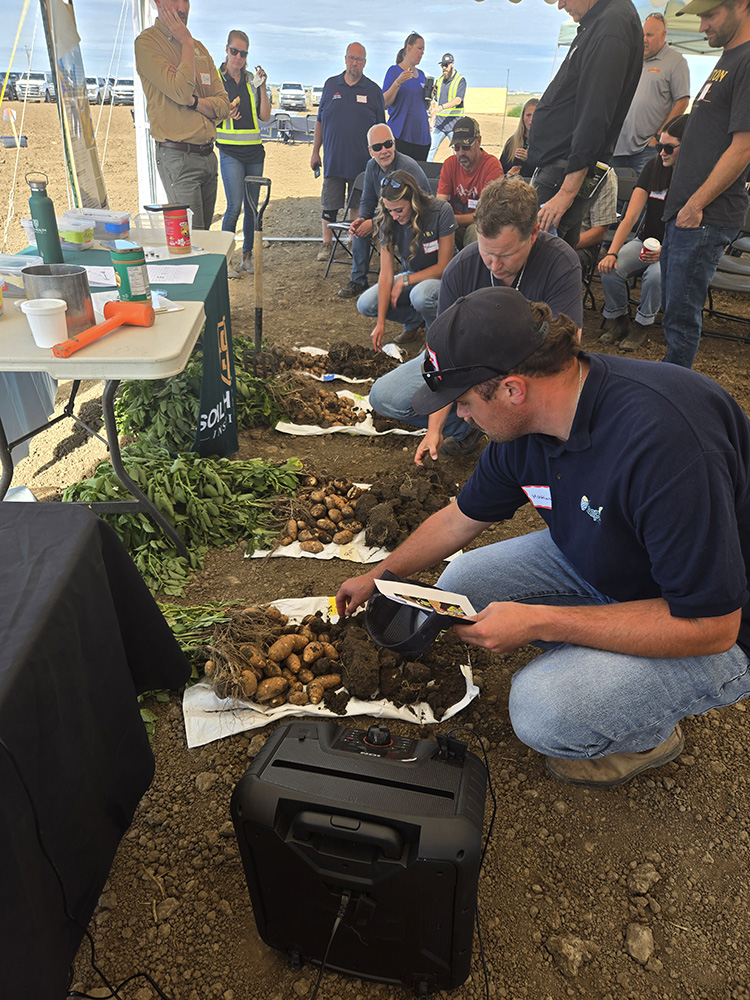
Southern Alberta’s irrigated systems, soil types and shorter growing season set it apart from many major potato regions. “We have later springs and earlier falls than Idaho,” Baarda noted. “Those things matter.”
The province does have a history of potato research, particularly out of Brooks, now continued at the University of Lethbridge by irrigated crop scientist and potato specialist Michele Konschuh. She sees Farming Smarter’s growing role as complementary rather than competitive.
“When Ken [Ken Coles, Farming Smarter executive director] first talked to me and asked if there was room for them to get into this, I said absolutely,” Konschuh said. “There’s less and less researchers all the time. Government cutbacks go back to 2002, and there’s more work than I could ever do."
She added that some types of work are better suited to applied research groups. “There’s work that isn’t really suitable for government and universities, especially confidential trials,” she said. “If you want to do spray trials or test products in that confidential space, Farming Smarter is a really great place for that.”
Baarda adds that Farming Smarter has a long track record of field experiment work. “We plan to use our research expertise to build the body of local agronomic knowledge in potato production as well.”
Building capacity on the ground
Konschuh also pointed to Farming Smarter’s recent investments in infrastructure as a turning point. With $800,000 from the province, the association purchased potato-specific equipment, including a hiller, planter, harvester, washer, grader, irrigation system and even a new tractor which is suited to deal with potato equipment.
“They bought a moveable boom, which is the closest thing you’re going to get to pivot irrigation and it’s portable,” Konschuh said. “That has made a real difference.”
"Despite these advances, Konschuh believes the region is still under-researched." |
She stressed that irrigation is non-negotiable for potato research in the region. “If another research group wanted to get into potatoes somewhere else in Alberta, I’d say you’re not in the right space,” she said. “You need irrigation. And southern Alberta is where that needs to happen.”
Despite these advances, Konschuh believes the region is still under-researched. “Not enough,” she said bluntly when asked how much potato research is happening in southern Alberta. “We each have a couple of projects, and that’s kind of how it feels. There’s more questions than we have answers – and maybe more questions than we have dollars."
Sugar beets: a different research model
Sugar beets present a contrasting picture. While acreage has declined from a four-year average of 28,000 acres to just over 22,000 acres in 2025, the crop has a tightly integrated research system through Lantic Sugar.
“I run the research program for Lantic,” said Jay Anderson, research agronomist with the company. “We do all the variety testing for commercial production, plus fertility, planting date, harvest timing, storage and hail simulation work.”
Lantic conducts 20 to 25 research projects annually, funded equally by the company and growers through a checkoff. “For a variety to be commercially approved, it has to produce a three-year average that meets or exceeds the average of the currently approved varieties,” Anderson said.
Because sugar beets are grown under contract and quota, outside research is more complicated. “Any group that wants to do sugar beet research needs to go through the Alberta Sugar Beet Growers marketing board and secure quota,” Anderson explained. “Seed is another limitation – Lantic is the only authorized dealer of seed in Canada.
“If Lewis [Baarda] wants to do work, we can put his acres on our research quota,” Anderson adds. “He can use our equipment and seed and take the data. That’s often the only way to make it work.”
Farming Smarter collaborated with Anderson and Lantic previously on some erosion mitigation work in sugar beets. “By working together to address knowledge gaps, we bring our own knowledge, expertise and capacity to the table,” notes Baarda.
Shared challenges, shared solutions
Even with a robust internal program, Anderson acknowledged there are limits. “I only have myself and one technician,” he said. “There are definitely some gaps, particularly around identifying the best long-term storage strategies with the climate variability we experience during the storage season.”
"Sometimes it's about trying what others have done and seeing if it works here too." |
Knowledge sharing is another challenge. “We’re fairly closed as a system, and I want to change that,” Anderson said. “Inviting more collaboration, more people to field days – that’s something we’re opening up to.”
Baarda sees sugar beets as emblematic of many specialty crops. “They don’t have the push of a canola or wheat commission,” he said. “They have limited resources and have to do a lot themselves.”
Beyond potatoes and beets, Farming Smarter is expanding into other niche areas, including seed canola, seed alfalfa and dry beans. “Seed canola is very much a southern Alberta thing because you need irrigation to de-risk it,” Baarda said. “We’ve got five-acre variety development trials for some companies. That’s a niche need we’re trying to address.”
Dry beans are another focus, supported by nearby processing capacity. “Agronomy for dry beans isn’t something the whole research world focuses on,” Baarda said. “We’re positioned to help support that, and we’ve got a strip-tillage trial rolling out this year.”
Closing the holes
For Baarda, the goal is not to replace external research, but to test it under local conditions. “There’s nothing wrong with pulling in information from other places,” he said. “But sometimes we have to replicate it here to know if the results hold up.”
Adapting and testing practices and technologies in a local context is only one part of the equation. Another piece is developing homegrown challenges to local challenges. “Our environment, cropping systems, irrigation, etc., presents unique challenges that may not be a consideration elsewhere,” said Baarda. “Similarly, it presents unique opportunities. We need to be able to think outside the box in collaboration with these specialty crop groups and their growers to ask the right questions, conduct the reliable research, and generate impactful knowledge to support local growers.”
Konschuh agrees. “I long ago thought I don’t need original ideas for everything,” she said. “Sometimes it’s about trying what others have done and seeing if it works here too.”
As southern Alberta’s specialty crop sectors evolve, the case for local research is becoming harder to ignore. “We have unique soils, irrigation, cooler nights and different disease pressures,” Anderson said. “Short answer: yes, you have to test by region.”
In filling those crop development holes, applied research organizations like Farming Smarter carve out a critical role – translating global knowledge into practical, local solutions that growers can trust.
Read more stories from the Farming Smarter Spring 2026 magazine below!
|
|
Building and Inspiring a Culture of Innovation in Western Canada AgricultureFarming Smarter is an agriculture innovation hub based out of Lethbridge, Alberta. Our mission is to support the people involved in advancing irrigated and dryland crop production. We work closely with farmers, entrepreneurs, businesses, government, academia and more to bridge the innovation gap, drive economic growth, improve social impact and environmental sustainability. We are a policy governed, non-profit organization with by-laws under the Alberta Societies Act, and a Canadian Charity registered under the Canada Revenue Agency. If you like what we do, please consider supporting Farming Smarter by making a donation, sponsoring us, or come to us for your agricultural research needs. Innovation is hard and about long-term results. We invite anyone interested in agriculture innovation to work with us and together we can change the way people farm. |

Other Articles
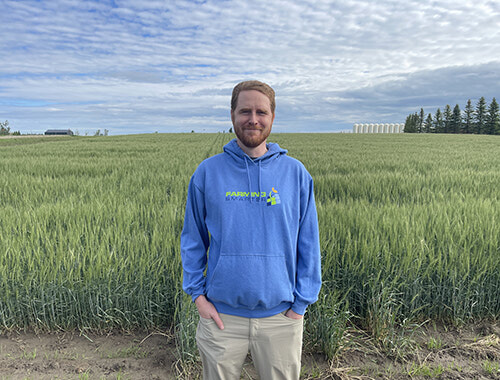
From Utrecht to Lethbridge, Dr. Thierry Fonville's journey to Farming Smarter includes more than 7,000 kilometers along with a venture into archeology research in the U.K. Now, Thierry's work focuses on bringing farmers across southern Alberta relevant research to aid their farms.
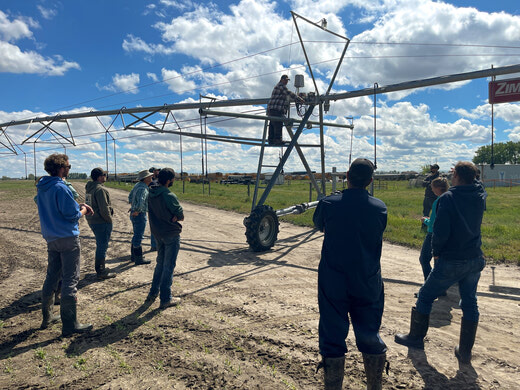
The inaugural Pivot School provided farmers with valuable insights on troubleshooting and repairing pivots.
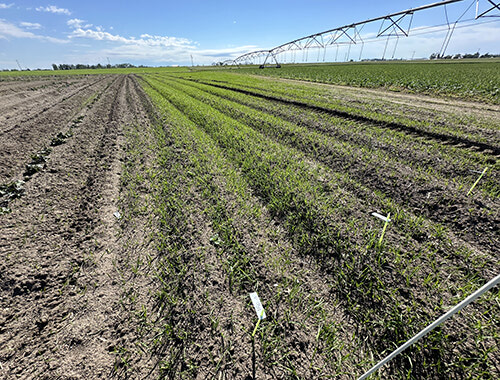
Updates on our research into how cover and nurse crops can help mitigate soil erosion in potato production.