
Oats can make for a hearty breakfast, but wild oats in your fields can leave you shaking your head in frustration.
Thankfully, farmers may soon have better tools to fight back. Farming Smarter has begun a three-year exploration into wild oat management that will test 27 treatments in small plot research trials.
Wild oats are an annual weed that cause continual problems for farmers across the Prairies. They compete with your crops for moisture and nutrients, leading to increased seed cleaning fees and decreased quality, and profitability, of their crops.
According to Carlo Van Herk, Field Operations Lead at Farming Smarter, wild oats can stay dormant in soil for up to 12 years, waiting for just the right conditions to come along so it can make its comeback.
“Once they become a problem, it takes a long time to get rid of the problem because you’re always going to have that weed seed bank,” says Van Herk.
He is among the crew taking on the new, multi-year demo plots. It aims to provide farmers with strategies on how to better control their wild oats.
This year, they have planted canola, peas, and wheat in areas with higher levels of wild oats and will experiment with different row spacing and seed rates.
Van Herk says he wants to see the difference in crop competition to wild oats throughout the season.
“The idea behind it is if we can get a thicker or a fuller crop, we'll have a quicker canopy closure or better canopy closure as well. Then, any wild oats that germinate won’t get sunlight and will be choked out instead,” says Van Herk. “It’ll really show us the difference between wide and narrow row spacing. Narrow row spacing will get us a quicker and better canopy closure compared to a wide row, and then a higher seed rate could also get us the quicker canopy closure as well.”
In 2027, treatments will include interrow tillage, spring tillage and winter wheat cover crops. In the following year, they’ll see whether a spring, summer or fall application of herbicides, or a combination of them with multiple actives, will provide the greatest benefit.
Our team will also silage barley for three consecutive years in a separate treatment.
Additionally, we are doing a one-year field scale demo in partnership with a nearby farmer.
There are 12 different treatments in the field scale demo, consisting of combinations of tillage, cover crops and Avadex herbicide applications.
“We should see a difference in wild oat pressure in the field demo as well, demonstrating a few known techniques for controlling wild oats” Van Herk explains.
Since wild oats management is a new project, we haven’t published any reports on it yet.
However, if you would like to learn more, we will be doing demonstrations at Farming Smarter Field School, which is coming up on June 25 and July 16, 2026.
You can register for Field School, among other Farming Smarter events, here.
|
|
Building and Inspiring a Culture of Innovation in Western Canada AgricultureFarming Smarter is an agriculture innovation hub based out of Lethbridge, Alberta. Our mission is to support the people involved in advancing irrigated and dryland crop production. We work closely with farmers, entrepreneurs, businesses, government, academia and more to bridge the innovation gap, drive economic growth, improve social impact and environmental sustainability. We are a policy governed, non-profit organization with by-laws under the Alberta Societies Act, and a Canadian Charity registered under the Canada Revenue Agency. If you like what we do, please consider supporting Farming Smarter by making a donation, sponsoring us, or come to us for your agricultural research needs. Innovation is hard and about long-term results. We invite anyone interested in agriculture innovation to work with us and together we can change the way people farm. |

Other Articles
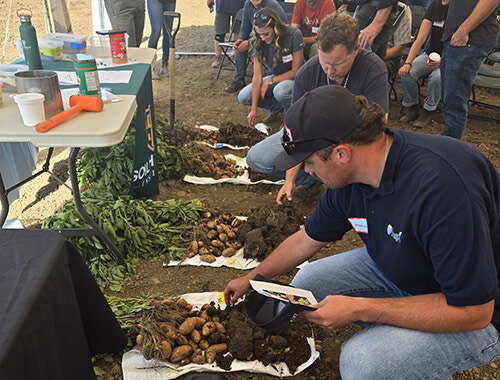
In agriculture, local conditions require local solutions. Specialty crops like potatoes and sugar beets underpin entire processing industries in southern Alberta yet lack region-specific information. Farming Smarter is working with these industries to provide that information and fill the "crop development holes".
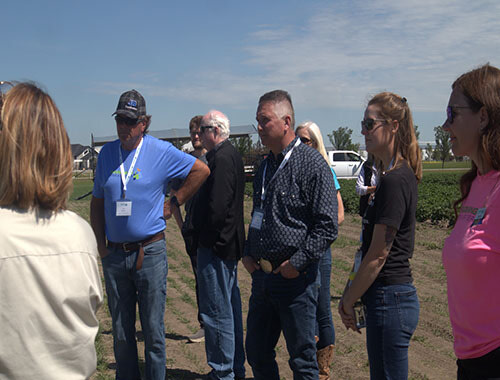
The Honourable Heath MacDonald, federal Minister of Agriculture and Agri-Food, visited Farming Smarter's research farm in Lethbridge to experience first-hand the value and impact of active collaboration in agronomy research.

Meet the experts ready to share their wisdom with you in the field at the Farming Smarter Field School on July 16! Don't wait to grab your tickets!